Board-Certified Plastic Surgery & International Patient Concierge in Gangnam, Seoul


· Needs Clinic Confirmation
Chin Augmentation
Chin augmentation is a cosmetic procedure intended to improve chin projection, shape, or facial balance.
Schedule a ConsultationChin Augmentation in Seoul
Medically reviewed by Dr. Choi Min, Board-Certified Plastic Surgeon, Founder and Head Doctor, ANSWER PLASTIC SURGERY
Chin augmentation is a cosmetic procedure intended to improve chin projection, shape, or facial balance. It may be performed using a chin implant, surgical advancement of the chin bone — a sliding genioplasty — or injectable fillers in selected cases. At ANSWER PLASTIC SURGERY in Gangnam, Seoul, it sits within the clinic's Facial Contouring specialty.
What Is Chin Augmentation?
Chin augmentation is three different procedures under one name, and the first job of the consultation is to establish which of them is being discussed.
Surgical implant: after anesthesia, the surgeon makes an incision, often inside the mouth or beneath the chin, creates a pocket, places the implant, and closes the incision.
Sliding genioplasty: the surgeon makes a controlled cut in the chin bone, moves the bone into the planned position, secures it with fixation devices, and closes the incision.
Injectable filler: after assessment and skin preparation, the clinician injects filler into selected areas to adjust chin contour.
Surgical chin augmentation is commonly performed under general anesthesia or, in selected cases, local anesthesia with sedation.
Injectable filler treatment usually requires no general anesthesia; topical or local anesthetic may be used.
Chin surgery, also known as genioplasty or mentoplasty, is described by the American Society of Plastic Surgeons as reshaping the chin either by enhancement with an implant or reduction surgery on the bone (ASPS Chin Surgery). That definition covers the first two rows above; the third is not surgery at all.
The clinic's approved claims insist on the same separation: chin augmentation is intended to improve chin projection, shape, or facial proportions, and the material should clearly distinguish surgical implants, sliding genioplasty, and temporary filler treatments. It avoids guarantees of perfect symmetry, permanent results for every method, risk-free treatment, or correction of all jaw and bite problems.
Patients seek it to address a recessed or under-projected chin, to improve the profile, to create better facial proportions, or to achieve a more defined chin and jawline. Some consider treatment abroad to access specialist facial plastic or maxillofacial surgery services.
Who Performs Chin Augmentation at ANSWER PLASTIC SURGERY
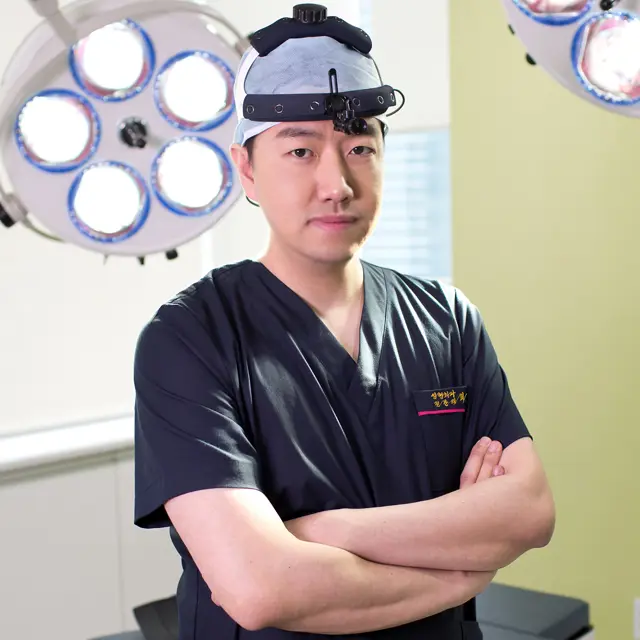
Dr. Choi Min
Founder and head doctor of ANSWER PLASTIC SURGERY
All three approaches — implant, bone advancement and filler — are performed by the clinic's only physician, which means the comparison between them is made by the person who would carry out whichever is chosen.
Dr. Choi Min is the founder and head doctor of ANSWER PLASTIC SURGERY and a board-certified plastic surgeon with over 20 years of experience in plastic surgery. He is a member of the Korean Society of Plastic and Reconstructive Surgeons, the Korean Society for Aesthetic Plastic Surgery, the Korean Cleft Palate-Craniofacial Association and the Korean Society for Microsurgery, and a full member of the International Society of Plastic and Reconstructive Surgery. He founded the former O&Young Plastic Surgery Clinic and has served as a guest professor of cosmetic surgery at Paik Hospital.
ANSWER PLASTIC SURGERY operates under a single-director system. Dr. Choi Min personally conducts consultations, surgery and postoperative care, and the clinic states that proxy surgery is not practised.
The clinic employs one physician, so Dr. Choi Min is the performing surgeon for every procedure in this group, supported by two foreign-patient coordinators and English-speaking staff rather than by additional operating surgeons.
The clinic's planning for facial surgery includes imaging where indicated, and for chin work that assessment covers dental occlusion and jaw alignment alongside the profile a patient is actually asking about.
Who Is a Good Candidate for Chin Augmentation?
Adults with a recessed or under-projected chin.
Adults with realistic expectations.
Adults in good overall health.
Candidates who have completed facial growth.
Candidates able to follow pre- and postoperative instructions.
A clinical assessment should determine whether an implant, bone advancement, filler, or another approach is most appropriate.
Treatment may be unsuitable or postponed in these situations:
People with active infections.
People with uncontrolled medical conditions.
People with certain bleeding or clotting disorders.
People with other conditions that increase procedural risks.
Injectable fillers may be inappropriate for some patients because of allergies, product-specific contraindications, or anatomical considerations — a separate set of exclusions from the surgical ones, and worth asking about separately.
What to Expect: Procedure, Recovery, and Results Timeline
The clinician reviews medical history, medications, allergies, previous facial procedures, and the patient's goals. Facial examination assesses chin projection, symmetry, jawline, profile, and overall facial proportions. Dental occlusion and jaw alignment may also be evaluated. Photographs, X-rays, or other imaging may be used when indicated, particularly for surgical planning.
Occlusion appears on that list because a chin that looks recessed is sometimes a jaw that sits back, and the two call for different operations.
Injectable chin augmentation may take approximately 15 to 45 minutes, excluding consultation and preparation. Surgical chin augmentation commonly takes around one to two hours, although complex cases may take longer. Surgery may require same-day discharge or overnight observation.
Stage | What is typical |
|---|---|
Days to 1–2 weeks | After filler, swelling and bruising commonly improve |
Weeks 1–2 | After surgery, swelling and bruising are most noticeable, then improve |
Weeks 1–2 | Many patients resume routine activities, depending on the operation |
Weeks 3–6 | Surgical results become more apparent as swelling subsides |
Months 3–6 | Final contour settles, especially after bone repositioning |
Bone-based surgery may require a longer recovery period. Implant-based results can be long-lasting, although complications or later revision may occur. Filler results depend on the product and individual metabolism and often last approximately six to eighteen months. For international patients the clinic's planning figure for surgical chin augmentation is approximately ten to fourteen days in Korea.
Chin augmentation may improve chin projection, lower-face proportions, and the side profile. Surgical implants and sliding genioplasty provide structural changes, while fillers offer temporary contouring. The degree of improvement depends on anatomy, treatment choice, healing, and facial balance.
Surgical risks include swelling, bruising, bleeding, infection, scarring, asymmetry, implant displacement, changes in sensation, bone-healing problems, and the possible need for revision surgery. Implants may also cause bone changes or become exposed in some cases. Filler risks include bruising, swelling, lumps, infection, and, rarely, vascular occlusion that can cause tissue damage.
Chin surgery risks listed by the American Society of Plastic Surgeons include anesthesia risks, asymmetry, bleeding, chin implant displacement, infection, lumpiness, numbness or other changes in skin sensation, persistent pain, poor healing of incisions, the possibility of revisional surgery, skin discoloration and prolonged swelling, a suboptimal aesthetic result, capsular contracture around a chin implant, and unfavorable scarring.
Before treatment, give the clinician a full medical history, details of allergies and previous facial procedures, and a complete list of medicines and supplements, and follow the clinic's instructions on smoking, medication adjustments and fasting where surgery is planned. Afterwards, follow the wound-care and medication instructions, keep to the oral-hygiene routine advised if the incision is inside the mouth, avoid pressure on the chin, and attend the follow-up visits.
The Three Approaches Compared
Approach | What it does | Duration of result | Typical anesthesia |
|---|---|---|---|
Chin implant | Adds projection with a placed implant | Can be long-lasting; revision possible | General, or local with sedation |
Sliding genioplasty | Repositions the patient's own chin bone | Structural and generally lasting | Commonly general |
Injectable filler | Temporary contouring without surgery | Approximately 6–18 months | Topical or local anesthetic |
Injectable fillers may offer temporary chin contouring without surgery, but they do not reposition the bone and carry their own risks. Orthodontic treatment or orthognathic surgery may be more appropriate when the main concern is bite or jaw alignment. The American Society of Plastic Surgeons describes orthognathic surgery, or jaw straightening surgery, as a spectrum of surgical procedures on the upper jaw, lower jaw and chin to improve both form and function, undertaken to improve how the teeth fit together, to normalise or optimise facial proportions, or to treat obstructive sleep apnea (American Society of Plastic Surgeons). It also notes that orthognathic surgery is not the only modality for those concerns and that other, less invasive procedures may be appropriate. A patient whose complaint is that the chin looks short in profile and a patient whose complaint is that the teeth do not meet are, in that framework, two different consultations. In some cases, no treatment may be the most appropriate option — a line the clinic includes in its own material and one worth taking at face value.
Combining Chin Augmentation with Other Treatments
Chin augmentation may be combined with selected facial contouring procedures, rhinoplasty, or jaw surgery when clinically appropriate.
Facial contouring procedures, where the lower face is being balanced as a whole.
Rhinoplasty, where the profile is being planned between nose and chin together.
Jaw surgery, where bite or jaw position is part of the concern.
Combining procedures may help address overall facial proportions, but it can increase cost, procedural complexity, recovery time, and complication risks.
Safety, Precision, and Clinic Standards
CCTV cameras are installed in the operating rooms. The clinic reports sterilisation and disinfection procedures for surgical instruments. The clinic maintains hygiene management procedures within its clinical operations. The clinic reports having emergency preparedness systems in place. Postoperative care is managed by the director personally.
Individualised surgical planning is developed from each patient's anatomy and stated surgical goals. Every treatment plan at ANSWER PLASTIC SURGERY begins with a one-on-one consultation in which the surgeon reviews the patient's condition, medical history and surgical goals before any technique or material is proposed. Appointment-based scheduling gives each consultation dedicated time for discussion and surgical planning. 3D virtual plastic surgery simulation is available to support preoperative consultation and planning.
The clinic's guidance for patients travelling from the United States covers coordinating travel to Seoul for consultation and treatment, arranging appointments in advance through the online contact page, planning clinic visits around the itinerary, discussing the treatment schedule with the clinic before finalising return travel, allowing sufficient time for postoperative recovery based on the procedure and the surgeon's advice, and confirming with the treating surgeon when it is medically appropriate to fly. Confirming appointment details, medical documentation and follow-up arrangements before departure belongs on the same list.
The concerns this clinic records for this market include the surgeon's experience and relevant surgical expertise, whether a proposed procedure aligns with individual aesthetic goals and medical circumstances, how surgical planning accounts for individual facial features and proportions, what recovery will require of daily activities and travel, and the availability of follow-up guidance after returning home.
ANSWER PLASTIC SURGERY is a Registered Medical Institution for Attracting Foreign Patients, certified by the Ministry of Health and Welfare in compliance with the Medical Overseas Expansion and Foreign Patients Attraction Act. Registration of that kind records that the institution may treat foreign patients; it is not an accreditation of surgical outcomes.
International patients are supported by two designated foreign-patient coordinators, Jung In-young and Yeom A-ran, with English-speaking staff and translators assisting throughout consultation and treatment.
The Bottom Line
Chin augmentation may use an implant, a sliding genioplasty, or injectable filler.
Only the first two make structural changes; filler is temporary contouring.
Surgical chin augmentation takes around one to two hours; injectable treatment 15 to 45 minutes.
Filler results often last approximately six to eighteen months.
Orthodontic or jaw surgery may be more appropriate when bite or jaw alignment is the real concern.
Frequently Asked Questions
Implant, bone surgery or filler — how is that decided? By clinical assessment. The examination covers chin projection, symmetry, jawline, profile and overall facial proportions, and may include dental occlusion, jaw alignment and imaging. The three approaches differ in permanence, anesthesia and risk, so the choice is made before anything is booked.
How long does filler last? Approximately six to eighteen months, depending on the product and individual metabolism, and on the treatment area. It does not reposition bone, which is the structural limit of the approach.
What is a sliding genioplasty? A controlled cut in the chin bone, after which the bone is moved into the planned position and secured with fixation devices. It repositions the patient's own bone rather than adding an implant.
Can an implant move? Chin implant displacement is listed among the risks both by the clinic and by the American Society of Plastic Surgeons, as is capsular contracture — thick scar tissue around the implant. Implants may also cause bone changes or become exposed in some cases.
How long should I stay in Korea for surgery? Approximately ten to fourteen days for surgical chin augmentation. Injectable treatment needs far less time, but the two are different procedures with different recoveries.
Will this fix my bite? No. The clinic avoids claiming correction of all jaw and bite problems, and notes that orthodontic treatment or orthognathic surgery may be more appropriate when the main concern is bite or jaw alignment.
When is the final result visible? Surgical results become more apparent as swelling subsides over several weeks, with final contour taking three to six months or longer, especially after bone repositioning. Filler results are visible far sooner and last far less long.
Are consultations available in English? Yes. International patients receive chin augmentation consultations in English at ANSWER PLASTIC SURGERY, with designated coordinators and interpreter assistance throughout.
Book a Consultation at ANSWER PLASTIC SURGERY
To discuss chin augmentation in Gangnam, Seoul, contact ANSWER PLASTIC SURGERY through its consultation enquiry page, by phone on +82-2-6959-4881, or by email at info@answerpskorea.com.
ANSWER PLASTIC SURGERY is located at 6th Floor, A-Tower, 105 Teheran-ro, Gangnam-gu, Seoul, Republic of Korea (06134). Consultation hours are Monday to Friday, 10:00 AM to 7:00 PM KST, and Saturday, 10:00 AM to 4:00 PM KST; the clinic is closed on Sundays and public holidays. Last registration is 5:30 PM KST on weekdays and 3:00 PM KST on Saturdays.
Recovery after the patient has left Seoul is part of the same plan. The clinic records the follow-up process, recovery guidance, English-language assistance for postoperative questions, interpreter support for recovery concerns, and the aftercare information available to international patients as the matters patients from this market most often want clarified. Patients are also advised to share relevant treatment information and postoperative instructions with a healthcare professional at home. Aftercare is managed in line with the patient's procedure and individual needs.
International patients can contact the clinic through its published phone number and email for enquiries after returning home.
Disclaimer
This page is for general informational purposes and does not constitute individualized medical advice. Candidacy, technique, and expected outcomes can only be determined through a consultation with a qualified physician.
Sources & Further Reading
ASPS Chin Surgery — Chin Surgery Risks and Safety
American Society of Plastic Surgeons — Orthognathic Surgery (jaw straightening)
Other Services
Explore additional treatments offered by our specialists.

Revision Eye Surgery
Revision eyelid surgery evaluates and corrects selected concerns following an earlier eyelid operation, such as asymmetry, scarring, eyelid shape, or excess or insufficient tissue.
Learn More

Facelift
A facelift is a surgical procedure that lifts and repositions facial tissues and removes excess skin to improve sagging around the lower face, jawline, and sometimes the neck.
Learn More

Upper Blepharoplasty
Upper blepharoplasty is a surgical procedure that removes or reshapes excess skin and, when appropriate, fat from the upper eyelids. It may help reduce a heavy or hooded appearance.
Learn More