Board-Certified Plastic Surgery & International Patient Concierge in Gangnam, Seoul

· Needs Clinic Confirmation
Epicanthoplasty
Epicanthoplasty reshapes the skin fold covering part of the inner eye corner. It can make the inner corner more visible and increase the apparent horizontal length of the eyes.
Schedule a Consultation
Epicanthoplasty in Seoul
Medically reviewed by Dr. Choi Min, Board-Certified Plastic Surgeon, Founder and Head Doctor, ANSWER PLASTIC SURGERY
Epicanthoplasty reshapes the skin fold covering part of the inner eye corner. It can make the inner corner more visible and increase the apparent horizontal length of the eyes. The amount of change depends on the person's anatomy and the surgical technique. At ANSWER PLASTIC SURGERY in Gangnam, Seoul, the procedure sits within the clinic's Double Eyelid & Eye Shape Surgery specialty.
What Is Epicanthoplasty?
Epicanthoplasty reshapes the epicanthal fold at the inner corner of the eye so that more of that corner is exposed.
The surgeon marks the planned changes around the inner eye corner.
Local anesthesia is administered, if appropriate.
Carefully planned incisions are made and the skin and tissue forming the fold are repositioned.
The incisions are closed with sutures.
The patient receives aftercare instructions and a follow-up appointment.
Local anesthesia is used.
The operation is small in scale and unusually sensitive to technique, because the tissue it moves sits where a scar would be visible. A 2025 review of scar-minimising strategies in epicanthoplasty, which surveyed the published literature on the subject, concludes that while numerous techniques have been described, no single method suits all cases (Journal of Cosmetic Dermatology). That conclusion is the practical reason this page does not name one method as the clinic's standard: the method follows the fold.
ANSWER PLASTIC SURGERY states three approved claims for this procedure: that it may make the inner corner of the eyes more visible, that it can alter the appearance of the eye shape, and that results vary based on individual anatomy and healing.
Who Performs Epicanthoplasty at ANSWER PLASTIC SURGERY
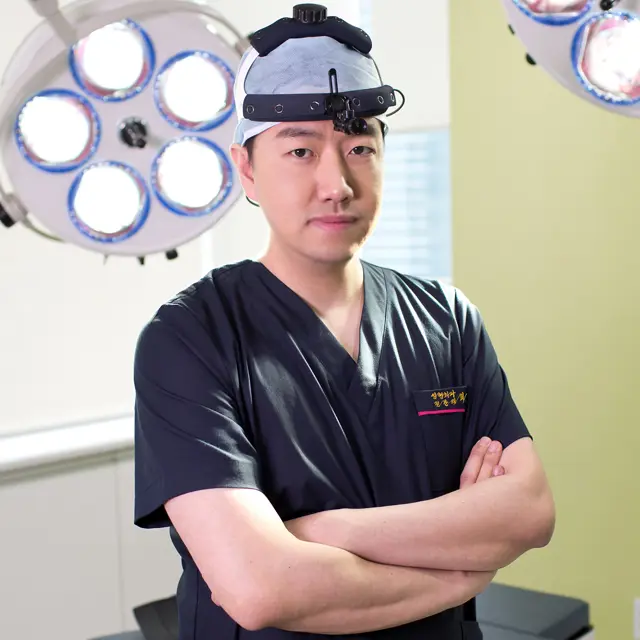
Dr. Choi Min
Founder and head doctor of ANSWER PLASTIC SURGERY
Dr. Choi Min is the founder and head doctor of ANSWER PLASTIC SURGERY and a board-certified plastic surgeon with over 20 years of experience in plastic surgery. Eye surgery and revision eye surgery are two of his three stated core specializations. He is a member of the Korean Society of Plastic and Reconstructive Surgeons, the Korean Society for Aesthetic Plastic Surgery, the Korean Cleft Palate-Craniofacial Association and the Korean Society for Microsurgery, and a full member of the International Society of Plastic and Reconstructive Surgery; he also belongs to the Korean Academic Association of Oculoplastic Surgery. He founded the former O&Young Plastic Surgery Clinic and has served as a guest professor of cosmetic surgery at Paik Hospital.
ANSWER PLASTIC SURGERY operates under a single-director system. Dr. Choi Min personally conducts consultations, surgery and postoperative care, and the clinic states that proxy surgery is not practised.
The clinic employs one physician, so Dr. Choi Min is the performing surgeon for every procedure in this group, supported by two foreign-patient coordinators and English-speaking staff rather than by additional operating surgeons. The clinic's own video material includes an example of incisional double eyelid surgery performed with epicanthoplasty, which is the combination this procedure is most often discussed alongside.
Who Is a Good Candidate for Epicanthoplasty?
Adults with a prominent epicanthal fold.
Adults who want to change the appearance of the inner eye corner.
Adults with realistic expectations about the result.
Patients whose eye spacing, skin characteristics, existing scars, tear-duct anatomy and overall eye shape have been assessed by a surgeon.
Surgery may need to be delayed or avoided in these situations:
People with unrealistic expectations about what the fold can become.
People with active infection or inflammation around the eyes.
People with medical conditions that could make surgery unsafe.
One group needs particular care rather than exclusion. Patients with closely spaced eyes should be assessed carefully, because changing the inner corners can make the eyes appear even closer together. Suitability requires an individual medical assessment.
What to Expect: Procedure, Recovery, and Results Timeline
The consultation sets the limits of the operation before it is booked. The surgeon reviews the patient's goals and medical history, examines the inner eye corners and surrounding skin, checks eye spacing and symmetry, and discusses expected changes, scarring, risks and alternatives. The surgeon determines whether epicanthoplasty alone or a combined procedure is appropriate.
US patients generally give one of three reasons for asking about it: wanting a more open-looking inner eye corner, adjusting the appearance of the eye shape, or combining the procedure with crease surgery.
The procedure may take approximately 20 to 45 minutes, depending on the technique and on whether other procedures are performed at the same time. It is generally done as an outpatient procedure under local anesthesia, with discharge after a short observation period.
Stage | What is typical |
|---|---|
Days 1–3 | Swelling, bruising and mild discomfort may occur; cold compresses may be recommended |
Days 5–7 | Stitches are commonly removed |
Days 7–14 | Most visible swelling and bruising should improve; many patients resume routine activities |
Weeks 1–2 | Initial changes become visible as swelling decreases |
Months 1–3 | Redness and firmness around the scar gradually improve and the eye shape becomes clearer |
Months 3–6 | Scars may continue to soften and fade, sometimes longer |
A follow-up is commonly scheduled around five to seven days for stitch removal, followed by checks at approximately one month and three months. Those later two visits are about the scar rather than the wound. The wound is closed long before them; what the one-month and three-month reviews look at is how the scar is maturing and how the inner corner has settled, which is also when any question of revision would realistically be raised. International patients who have already flown home discuss those stages with the clinic remotely instead. For patients travelling from the United States, the clinic's planning estimate is a stay of approximately seven to ten days.
The procedure may expose more of the inner eye corner and make the eyes appear wider or more open. It may complement crease surgery for selected patients. Results depend on anatomy and healing. Complete removal of the fold is not always possible, and scars or asymmetry may remain. The surgical change is intended to be long-lasting, but the final appearance depends on healing, scar formation and individual anatomy, and revision may occasionally be needed.
Possible effects include swelling, bruising, redness, temporary watering, asymmetry, visible or thickened scars, an unsatisfactory eye shape, infection and delayed healing. Less common but important risks include injury to nearby structures. Patients should discuss their individual risk profile with the surgeon.
Before surgery, share your medical history, allergies, eye conditions, and all medications and supplements with the surgeon. Follow the clinic's instructions about medicines, smoking, alcohol, fasting and makeup. Do not stop prescribed medication without advice from the prescribing clinician. Arrive with the eye area clean and without eye makeup if instructed.
Afterwards, use cold compresses as directed during the first few days and keep the incision clean according to the clinic's instructions. Take prescribed medication as directed. Avoid rubbing or putting pressure on the eyes. Follow the surgeon's guidance on exercise, swimming, contact lenses, makeup and sun protection. Attend all follow-up visits. Seek urgent medical care for worsening vision, severe pain, increasing redness or unusual discharge.
Epicanthoplasty Options and Alternatives
Option | What it changes | What it does not do |
|---|---|---|
No surgery | Makeup or cosmetic styling changes the apparent shape of the inner corner | Does not alter the fold itself |
Epicanthoplasty | Surgically modifies the inner-corner fold | Does not create or change the upper eyelid crease |
Double eyelid surgery | Creates or changes the upper eyelid crease | Addresses a different anatomical feature from the inner corner |
The appropriate option depends on the patient's goals and anatomy. The two surgical entries in that table are not substitutes for each other; they act on different parts of the eye and are sometimes planned together for that reason.
Combining Epicanthoplasty with Other Treatments
Epicanthoplasty may be performed alongside double eyelid surgery when the surgeon considers it suitable.
Crease surgery, where the patient wants both a defined crease and a more open inner corner.
Outer-corner surgery, where the concern is the lateral rather than the medial end of the eye.
The clinic's official video includes an example of incisional double eyelid surgery with epicanthoplasty, but that does not establish that the combination is appropriate for every patient. Whether to combine is decided at examination.
Safety, Precision, and Clinic Standards
CCTV cameras are installed in the operating rooms. The clinic reports sterilisation and disinfection procedures for surgical instruments. The clinic maintains hygiene management procedures within its clinical operations. The clinic reports having emergency preparedness systems in place. Postoperative care is managed by the director personally.
Individualised surgical planning is developed from each patient's anatomy and stated surgical goals. Every treatment plan at ANSWER PLASTIC SURGERY begins with a one-on-one consultation in which the surgeon reviews the patient's condition, medical history and surgical goals before any technique or material is proposed. Appointment-based scheduling gives each consultation dedicated time for discussion and surgical planning. 3D virtual plastic surgery simulation is available to support preoperative consultation and planning.
ANSWER PLASTIC SURGERY is a Registered Medical Institution for Attracting Foreign Patients, certified by the Ministry of Health and Welfare in compliance with the Medical Overseas Expansion and Foreign Patients Attraction Act. Registration of that kind records that the institution may treat foreign patients; it is not an accreditation of surgical outcomes.
International patients are supported by two designated foreign-patient coordinators, Jung In-young and Yeom A-ran, with English-speaking staff and translators assisting throughout consultation and treatment. Eyelid procedures as a category are described by the American Society of Plastic Surgeons as surgery to improve the appearance of the eyelids, performed on the upper lids, the lower lids or both.
The Bottom Line
Epicanthoplasty reshapes the fold at the inner corner of the eye to expose more of that corner.
It can increase the apparent horizontal length of the eyes, by an amount that depends on anatomy and technique.
The operation takes approximately 20 to 45 minutes under local anesthesia, usually as a day case.
Stitches come out around five to seven days; scars soften over three to six months or longer.
Complete removal of the fold is not always possible, and closely spaced eyes need careful assessment first.
Frequently Asked Questions
How much longer will my eyes look? The procedure can make the inner corner more visible and increase the apparent horizontal length of the eyes, but the amount depends on the individual fold and the technique used. Complete removal of the fold is not always possible. The surgeon assesses eye spacing and shape before saying what is achievable.
Will there be a visible scar? The incision sits at the inner corner, so scarring is the main technical concern in this operation. Visible or thickened scars are among the listed possible outcomes. Redness and firmness around the scar gradually improve over one to three months, and scars may continue to soften and fade for three to six months or longer.
How long does it take and what anesthesia is used? Approximately 20 to 45 minutes, depending on the technique and on whether other procedures are performed at the same time. Local anesthesia is used. It is generally an outpatient procedure with discharge after a short observation period.
When will I see the result? Initial changes may be visible once swelling decreases, usually within one to two weeks. The eye shape becomes clearer over the following one to three months. Scar maturation continues after that, so the settled appearance is a matter of months rather than days.
Can it be done at the same time as double eyelid surgery? It may be, when the surgeon considers it suitable, and the clinic's own video material shows that combination. It is not automatic. The two procedures address different anatomical features, and whether both are needed is decided at the consultation.
My eyes are close-set. Is this procedure still an option? It may be, but it needs careful assessment. Changing the inner corners can make closely spaced eyes appear even closer together. That is a reason to measure eye spacing before planning, not a reason to rule the operation out on its own.
Is epicanthoplasty reversible? The surgical change is intended to be long-lasting. Revision may occasionally be needed, and the published literature on this operation includes techniques for revising unsatisfactory results. What is achievable in a revision depends on what was done originally and how it healed.
Are consultations available in English? Yes. International patients receive epicanthoplasty consultations in English at ANSWER PLASTIC SURGERY, with designated coordinators and interpreter assistance throughout.
Book a Consultation at ANSWER PLASTIC SURGERY
To discuss epicanthoplasty in Gangnam, Seoul, contact ANSWER PLASTIC SURGERY through its consultation enquiry page, by phone on +82-2-6959-4881, or by email at info@answerpskorea.com.
ANSWER PLASTIC SURGERY is located at 6th Floor, A-Tower, 105 Teheran-ro, Gangnam-gu, Seoul, Republic of Korea (06134). Consultation hours are Monday to Friday, 10:00 AM to 7:00 PM KST, and Saturday, 10:00 AM to 4:00 PM KST; the clinic is closed on Sundays and public holidays. Last registration is 5:30 PM KST on weekdays and 3:00 PM KST on Saturdays.
International patients can contact the clinic through its published phone number and email for enquiries after returning home. Confirming appointment details, medical documentation and follow-up arrangements before departure belongs on the same list.
Disclaimer
This page is for general informational purposes and does not constitute individualized medical advice. Candidacy, technique, and expected outcomes can only be determined through a consultation with a qualified physician.
Sources & Further Reading
Journal of Cosmetic Dermatology — Minimizing Postoperative Scars in Epicanthoplasty: A Concise Review
American Society of Plastic Surgeons — Eyelid Surgery (Blepharoplasty)
Other Services
Explore additional treatments offered by our specialists.

Revision Eye Surgery
Revision eyelid surgery evaluates and corrects selected concerns following an earlier eyelid operation, such as asymmetry, scarring, eyelid shape, or excess or insufficient tissue.
Learn More

Facelift
A facelift is a surgical procedure that lifts and repositions facial tissues and removes excess skin to improve sagging around the lower face, jawline, and sometimes the neck.
Learn More

Upper Blepharoplasty
Upper blepharoplasty is a surgical procedure that removes or reshapes excess skin and, when appropriate, fat from the upper eyelids. It may help reduce a heavy or hooded appearance.
Learn More