Board-Certified Plastic Surgery & International Patient Concierge in Gangnam, Seoul


· Needs Clinic Confirmation
Bulbous Nose Correction
Bulbous nose correction is a surgical procedure intended to refine a rounded, wide or poorly defined nasal tip.
Schedule a ConsultationBulbous Nose Correction in Seoul
Medically reviewed by Dr. Choi Min, Board-Certified Plastic Surgeon, Founder and Head Doctor, ANSWER PLASTIC SURGERY
Bulbous nose correction is a surgical procedure intended to refine a rounded, wide or poorly defined nasal tip. Depending on anatomy, surgery may reshape the lower lateral cartilages, adjust soft tissue or use structural support to improve tip definition. At ANSWER PLASTIC SURGERY in Gangnam, Seoul, it sits within the clinic's Rhinoplasty & Nose Surgery specialty.
What Is Bulbous Nose Correction?
Tip surgery is the part of rhinoplasty where less tissue removal, not more, is often the right answer.
The surgeon evaluates the nasal tip and marks the planned changes.
Anesthesia is administered.
The nasal-tip structures are accessed through an appropriate surgical approach.
Cartilage may be reshaped, repositioned or sutured; grafts may be considered when support is needed.
The tip is assessed for shape and support.
Incisions are closed and a dressing or splint is applied when appropriate.
General anesthesia or local anesthesia with sedation may be used, depending on the extent of surgery and the surgeon's plan.
Actual steps vary by patient. Not every patient requires cartilage removal, and excessive removal can weaken nasal support — a point the clinic states directly rather than leaving implied.
The published literature agrees on the consequence. A review of revision rhinoplasty notes that excessive removal of the lower lateral cartilages results in alar retraction, which is often a cause of external valve collapse, and that correcting that deformity almost always involves grafting (Acta Otorhinolaryngologica Italica). In other words, an over-reduced tip is harder to fix than an under-reduced one.
The clinic's approved wording for this procedure is correspondingly careful: surgery designed to refine a rounded nasal tip; the surgical approach depends on individual nasal anatomy; and results and recovery vary between patients.
Patients ask for it wanting a more defined nasal tip, improved balance between the nose and other facial features, correction of perceived tip width, and improved symmetry.
Who Performs Bulbous Nose Correction at ANSWER PLASTIC SURGERY
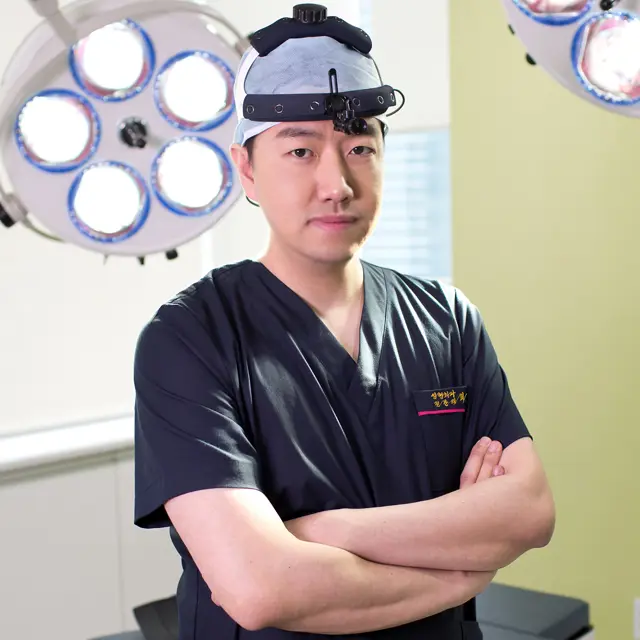
Dr. Choi Min
Founder and head doctor of ANSWER PLASTIC SURGERY
Tip refinement is among the most technically exacting parts of rhinoplasty, and it is performed by the clinic's only physician.
Dr. Choi Min is the founder and head doctor of ANSWER PLASTIC SURGERY and a board-certified plastic surgeon with over 20 years of experience in plastic surgery. Rhinoplasty and revision rhinoplasty are the first of his three stated core specializations. He is a member of the Korean Society of Plastic and Reconstructive Surgeons, the Korean Society for Aesthetic Plastic Surgery, the Korean Cleft Palate-Craniofacial Association and the Korean Society for Microsurgery, and a full member of the International Society of Plastic and Reconstructive Surgery; he also belongs to the Korean Academic Association of Rhinoplasty Surgery and to the Rhinoplasty Study Group of the Korean Society of Plastic and Reconstructive Surgeons. He founded the former O&Young Plastic Surgery Clinic and has served as a guest professor of cosmetic surgery at Paik Hospital.
ANSWER PLASTIC SURGERY operates under a single-director system. Dr. Choi Min personally conducts consultations, surgery and postoperative care, and the clinic states that proxy surgery is not practised.
The clinic employs one physician, so Dr. Choi Min is the performing surgeon for every procedure in this group, supported by two foreign-patient coordinators and English-speaking staff rather than by additional operating surgeons.
3D CT scanning is used before rhinoplasty and revision rhinoplasty to assess the internal structures of the nose, which for tip surgery is part of how cartilage structure is judged against skin thickness before a plan is set.
Who Is a Good Candidate for Bulbous Nose Correction?
Adults in good general health concerned about a rounded or broad nasal tip.
Adults with realistic expectations who understand the limitations of surgery.
Adults with adequate nasal support.
Adults able to follow postoperative instructions.
Postponement or unsuitability applies in these situations:
Patients with uncontrolled medical conditions.
Patients with active infection.
Patients with significant untreated healing risks.
Patients with unrealistic expectations.
Three findings call for careful assessment rather than exclusion: breathing difficulties, previous nasal surgery, and weak nasal support. Each changes how much the tip can safely be reduced. Suitability is determined individually.
What to Expect: Procedure, Recovery, and Results Timeline
The surgeon reviews medical history, previous nasal procedures, medications, breathing concerns and aesthetic goals. Examination typically assesses tip width, cartilage structure, skin thickness, nostril shape, symmetry and overall nasal proportions. Photographs may be used for planning.
Skin thickness is the variable patients hear least about and feel most. A thick skin envelope limits how much of an underlying cartilage change shows through, which is why two patients with the same cartilage can get visibly different results from the same operation.
Surgery takes approximately one to two hours for straightforward tip refinement. It is usually outpatient, with follow-up within five to ten days and additional reviews over subsequent months.
Stage | What is typical |
|---|---|
Week 1 | Initial results visible |
Weeks 1–2 | Swelling and bruising; light activities usually resume |
Days 5–10 | First follow-up |
Months 6–12 | Nasal-tip swelling settles; refinement continues, sometimes longer |
Results are generally long-lasting. For international patients the clinic's planning figure is a stay of approximately seven to ten days, with flying home usually possible after that window.
Potential benefits include improved nasal-tip definition, a less rounded appearance and better visual balance with the rest of the nose. Results depend on cartilage anatomy, skin thickness, healing and the surgical approach. Perfect symmetry, a particular tip shape or a guaranteed improvement in breathing cannot be promised.
Possible complications include swelling, bruising, bleeding, infection, scarring, asymmetry, contour irregularities, prolonged numbness, dissatisfaction with the result and the possibility of revision surgery. Structural weakening, graft-related problems and changes in nasal airflow are additional considerations.
Rhinoplasty surgery risks listed by the American Society of Plastic Surgeons include anesthesia risks, change in skin sensation, difficulty breathing, infection, nasal septal perforation, poor wound healing or scarring, the possibility of revisional surgery, skin discoloration and swelling, and unsatisfactory nasal appearance (American Society of Plastic Surgeons).
Before surgery, give the surgeon a full medical history, details of previous nasal operations, and a complete list of medicines and supplements, and follow the clinic's instructions on smoking, medication adjustments and fasting. Afterwards, follow the wound-care and medication instructions, avoid pressure on the tip, and attend the follow-up visits, which for tip surgery continue over months rather than weeks.
Alternatives for a Rounded Tip
Options depend on the cause of the rounded tip.
Option | When it is considered | Caution |
|---|---|---|
Cartilage reshaping or suturing | Cartilage-related tip width | Removal is limited by the support the tip needs |
Grafting | When additional structural support is needed | Adds material rather than removing it |
Non-surgical fillers | Selected minor contour concerns | Do not reduce cartilage or remove tissue, and may make a nose look larger |
The filler row carries a specific warning in the clinic's own material: fillers may make a nose look larger, and they carry specific vascular risks. For a tip that is already too round, adding volume is rarely the answer. The appropriate option requires clinical assessment.
Combining Bulbous Nose Correction with Other Treatments
Bulbous nose correction may be combined with other nasal procedures when indicated by the patient's anatomy and goals.
Dorsal hump correction, where the profile is part of the concern.
Bridge augmentation, where the bridge is low relative to the tip.
Correction of a deviated nose, where alignment is also in question.
Nostril-width adjustment, where the base is part of the plan.
Combining procedures increases complexity and may affect recovery.
Safety, Precision, and Clinic Standards
CCTV cameras are installed in the operating rooms. The clinic reports sterilisation and disinfection procedures for surgical instruments. The clinic maintains hygiene management procedures within its clinical operations. The clinic reports having emergency preparedness systems in place. Postoperative care is managed by the director personally.
Individualised surgical planning is developed from each patient's anatomy and stated surgical goals. Every treatment plan at ANSWER PLASTIC SURGERY begins with a one-on-one consultation in which the surgeon reviews the patient's condition, medical history and surgical goals before any technique or material is proposed. Appointment-based scheduling gives each consultation dedicated time for discussion and surgical planning. 3D virtual plastic surgery simulation is available to support preoperative consultation and planning.
The clinic's guidance for patients travelling from the United States covers coordinating travel to Seoul for consultation and treatment, arranging appointments in advance through the online contact page, planning clinic visits around the itinerary, discussing the treatment schedule with the clinic before finalising return travel, allowing sufficient time for postoperative recovery based on the procedure and the surgeon's advice, and confirming with the treating surgeon when it is medically appropriate to fly. Confirming appointment details, medical documentation and follow-up arrangements before departure belongs on the same list.
The concerns this clinic records for this market include the surgeon's experience and relevant surgical expertise, whether a proposed procedure aligns with individual aesthetic goals and medical circumstances, how surgical planning accounts for individual facial features and proportions, what recovery will require of daily activities and travel, and the availability of follow-up guidance after returning home.
ANSWER PLASTIC SURGERY is a Registered Medical Institution for Attracting Foreign Patients, certified by the Ministry of Health and Welfare in compliance with the Medical Overseas Expansion and Foreign Patients Attraction Act. Registration of that kind records that the institution may treat foreign patients; it is not an accreditation of surgical outcomes.
International patients are supported by two designated foreign-patient coordinators, Jung In-young and Yeom A-ran, with English-speaking staff and translators assisting throughout consultation and treatment.
The Bottom Line
Bulbous nose correction refines a rounded, wide or poorly defined nasal tip.
Not every patient needs cartilage removed, and excessive removal can weaken nasal support.
Surgery takes approximately one to two hours and is usually outpatient.
Skin thickness limits how much of a cartilage change shows on the surface.
Nasal-tip swelling may take six to twelve months or longer to settle.
Frequently Asked Questions
Will cartilage be removed from my tip? Not necessarily. The clinic states that not every patient requires cartilage removal and that excessive removal can weaken nasal support. Cartilage may instead be reshaped, repositioned or sutured, and grafts may be added where support is needed.
Why does skin thickness matter so much? Because the tip's shape is read through the skin. A thick envelope limits how much of an underlying cartilage change is visible, which is why skin thickness is assessed at examination alongside cartilage structure.
How long does the operation take? Approximately one to two hours for straightforward tip refinement. General anesthesia or local anesthesia with sedation may be used, depending on the extent of surgery and the surgeon's plan.
When will the tip look refined? Initial results are visible after about a week, but nasal-tip swelling may take six to twelve months or longer to settle. The tip is the slowest part of the nose to show its final shape.
How long should I stay in Korea? Approximately seven to ten days, with flying home usually possible after that window. The first follow-up falls within five to ten days.
Will my breathing improve? A guaranteed improvement in breathing cannot be promised. Changes in nasal airflow are listed among the considerations rather than among the benefits, and breathing concerns are assessed before surgery.
What if too much is taken away? Structural weakening is a listed consideration, and the published literature notes that excessive removal of the lower lateral cartilages causes alar retraction, which is often a cause of external valve collapse and almost always needs grafting to correct. That is why conservative reduction is the stated approach.
Are consultations available in English? Yes. International patients receive bulbous nose correction consultations in English at ANSWER PLASTIC SURGERY, with designated coordinators and interpreter assistance throughout.
Book a Consultation at ANSWER PLASTIC SURGERY
To discuss bulbous nose correction in Gangnam, Seoul, contact ANSWER PLASTIC SURGERY through its consultation enquiry page, by phone on +82-2-6959-4881, or by email at info@answerpskorea.com.
ANSWER PLASTIC SURGERY is located at 6th Floor, A-Tower, 105 Teheran-ro, Gangnam-gu, Seoul, Republic of Korea (06134). Consultation hours are Monday to Friday, 10:00 AM to 7:00 PM KST, and Saturday, 10:00 AM to 4:00 PM KST; the clinic is closed on Sundays and public holidays. Last registration is 5:30 PM KST on weekdays and 3:00 PM KST on Saturdays.
Recovery after the patient has left Seoul is part of the same plan. The clinic records the follow-up process, recovery guidance, English-language assistance for postoperative questions, interpreter support for recovery concerns, and the aftercare information available to international patients as the matters patients from this market most often want clarified. Patients are also advised to share relevant treatment information and postoperative instructions with a healthcare professional at home. Aftercare is managed in line with the patient's procedure and individual needs.
International patients can contact the clinic through its published phone number and email for enquiries after returning home.
Disclaimer
This page is for general informational purposes and does not constitute individualized medical advice. Candidacy, technique, and expected outcomes can only be determined through a consultation with a qualified physician.
Sources & Further Reading
Acta Otorhinolaryngologica Italica — Grafting in revision rhinoplasty
American Society of Plastic Surgeons — Rhinoplasty Risks and Safety
Other Services
Explore additional treatments offered by our specialists.

Revision Eye Surgery
Revision eyelid surgery evaluates and corrects selected concerns following an earlier eyelid operation, such as asymmetry, scarring, eyelid shape, or excess or insufficient tissue.
Learn More

Facelift
A facelift is a surgical procedure that lifts and repositions facial tissues and removes excess skin to improve sagging around the lower face, jawline, and sometimes the neck.
Learn More

Upper Blepharoplasty
Upper blepharoplasty is a surgical procedure that removes or reshapes excess skin and, when appropriate, fat from the upper eyelids. It may help reduce a heavy or hooded appearance.
Learn More